
A prescription for moral nausea

Ze'ev Jabotinsky. A cure for Oslo Syndrome nausea.

Ze’ev Jabotinsky. A cure for Oslo Syndrome nausea.

We were not created in order to teach morals and manners to our enemies. Let them learn these things for themselves before they establish relations with us. We want to hit back at anybody who harms us. Whoever does not repay a blow by a blow is also incapable of repaying a good deed in kind. Only someone who can hate his enemies can be a faithful friend to those who love him. — Ze’ev Jabotinsky

I received this article this morning, from that bastion of Zionism, the Union for Reform Judaism. The author is Marc Rosenstein, a Reform rabbi and former American living in a Galilee moshav. He often writes about the nuances of Jewish-Arab relations and apparently believes that the conflict is driven by ‘extremists on both sides’. I think this time his moral obtuseness has pushed me over the edge:

I cannot watch without nausea the stern-faced generals solemnly assuring us “we will stop at nothing to bring the boys home” (when they already knew they were dead), or that “we will teach Hamas a lesson they will never forget” (when, based on all our past efforts at such pedagogy, it is clear that Hamas is learning-disabled, or we are poor teachers).  Anger – at leaders on both sides who have failed all of us, whose calculations of what is best for their people are too esoteric, I guess, for us ordinary citizens to understand; I certainly don’t get it.  At the same time, I am frustrated by the fact that if I were in their place, I’m not sure what I would do; the rights and wrongs are tangled and blurry; the challenge of presenting a positive vision that would harmonize all needs and interests is huge.  On the other hand, to present no positive vision at all seems to me to be a failure of leadership.

Rosenstein has made a shockingly ugly accusation. They did not “already know” the boys were dead. There certainly was evidence that something terrible had happened in that car, but would it not have been far worse to announce that they were dead and stop looking so hard, if in fact even one of the boys were still alive? And even if they were dead, was it not important to bring their bodies home, out of the hands of those ghouls?

Hamas doesn’t need a lesson. It needs to have its rockets and tunnels taken away, and its leaders need to be dead. Right and wrong are not “tangled and blurry” at all — there is a clear moral issue here, which is that Hamas is flat-out evil, and in its zeal to kill as many Jews as possible, is also causing the deaths of Palestinians, some of whom are entirely innocent. Read the Hamas Covenant. This isn’t hard for an “ordinary citizen” like me to understand, so why is it for Rosenstein?

He expresses “anger — at leaders on both sides who have failed us,” I presume because they haven’t signed an agreement to surrender Judea and Samaria to the PLO. The most charitable way I can respond is to say that intransigent Arab leaders have saved us from stupid Jewish leaders with delusions of moral superiority (like Rosenstein) who were literally begging to be scammed into surrendering the security of all Israelis.

Then he takes on people like me:

I avoid as much as possible reading the dialogue of the deaf that apparently fills the cybersphere, both in Israel and in America, because its participants insist on wallowing in the discourse of competitive victimhood which has gotten us to the mess we’re in.  The other side is the great satan and we are innocent victims who are obviously in no way responsible for any of the terrible things that are happening to us.  So we can do nothing.  “He made me do it” was the way my eighth grade students used to put it.

“Wallowing in the discourse of competitive victimhood.” I bet he thinks that is such a great line! But the whole idea is not to be a victim, to defend oneself and to deter one’s enemies. Jabotinsky, Begin, and Ben-Gurion all understood this simple point. Today’s post-Zionist Left, who are in fact the ones who have “gotten us to the mess we’re in”  by way of Oslo, apparently does not.

Why does he find it so hard to accept that “the other side” is fully responsible for its murderous actions? In precisely what way are we responsible? What options for compromise do we have short of surrender? Of course I know that there are innocent Palestinians caught in the crossfire, even children, even babies. So would it be better if we allowed innocent Jewish children to be murdered in their place?

This is choice we have, between killing them or letting them kill us. Yes it’s a very rotten situation, what the psychologists call a ‘double bind’, something that is hard for anyone to bear. But suicide is not an acceptable solution.

Here’s the real cause of Rosenstein’s nausea: it’s called the Oslo Syndrome: the disorder characterized by responding to enemies who hate and want to kill you by coming to believe that maybe they have a point, by believing that you have the power to defuse anti-Jewish hatred by being better.

You don’t. They hate you and want to kill you because that is how they are. Stop thinking that you can make them like you, and start defending yourself.

Rosenstein can be cured. He should take two doses of Jabotinsky and call me in the morning.

Posted in Post-Zionism, War, Zionism | 1 Comment

Hamas takes aim at Israel’s lifeline

Departure board at Ben Gurion Airport. It is Israel's main connection to the rest of the world.

Departure board at Ben Gurion Airport. It is Israel’s main connection to the rest of the world.

News item:

In a sign of increased caution about flying near combat zones, US and European airlines halted flights to Israel Tuesday after a rocket landed near Tel Aviv’s Ben Gurion Airport.

Delta Air Lines and United Airlines suspended service between the US and Israel indefinitely. US Airways scrapped its one flight to Tel Aviv Tuesday. Germany’s Lufthansa and Air France also suspended flights. The actions come days after a Malaysia Airlines jet was shot down over eastern Ukraine with 298 people on board.

Following the action by the US airlines, the Federal Aviation Administration prohibited US airlines from flying to the Tel Aviv airport for 24 hours.

This is a very grave development. Ben-Gurion airport is Israel’s main connection to the rest of the world. The economic and psychological disruption that could occur if it were to be closed for a long period would be very severe.

The immediate cause was a Hamas rocket which landed in Yahud, about 1 mile away, and it appears that Hamas is now trying to fire rockets in this direction, as they have threatened to do. Although the airport itself is protected by an Iron Dome system, it’s easy to see why airlines might be nervous. It’s hard enough flying into busy airspace without having to worry about rockets falling from the sky and Tamir missiles coming up to meet them from below.

In fact, one of the most powerful arguments against withdrawing from Judea and Samaria is that it would enable terrorists to subject the airport to the kind of bombardment that has so far been reserved for Sderot and the kibbutzim next door to Gaza.

Israel’s Transportation Ministry says that the airport is safe, and El Al will keep flying. But Hamas should understand that they have significantly raised the ante by targeting the airport, and escalation will be matched by escalation. We can expect the IDF to push harder to find and destroy long-range rockets and launchers.

Hamas believes that its human shield strategy will continue to constrain Israel and protect its headquarters and rocket launchers. But there is a limit to how much pressure the international community can apply, and if Israel’s leaders feel that the threat from Hamas is approaching an unacceptable level, they might loosen rules of engagement and stop answering the phone. I think a rocket barrage aimed at the airport falls into this category.

This is even more evidence, if any more is needed, that there must be no ceasefire until Hamas’ offensive capabilities are fully neutralized — whatever that takes.

Posted in Terrorism, War | Comments Off on Hamas takes aim at Israel’s lifeline

The road to peace runs through victory

This bloody past suggests to us that enemies cease hostilities only when they are battered enough to acknowledge that there is no hope in victory — and thus that further resistance means only useless sacrifice.Victor Davis Hanson

Many of us have welcomed statements from various world leaders, including those of the US, which affirm Israel’s right to defend herself, and accuse Hamas of aggression and war crimes.

As I have written countless times — particularly with respect to the US — it isn’t words that count, it is actions. And sometimes what appear to be supportive words are accompanied by actions that are not so supportive.

For example, here is John Kerry responding to a question from Fox News’ Chris Wallace:

QUESTION: Secretary Kerry, when you said it’s a hell of a pinpoint operation, are you upset that the Israelis are going too far, and in fact, do you intend to go back to the Middle East tonight, sir?

SECRETARY KERRY: I think it’s very, very difficult in these situations, obviously very difficult, Chris. You have people who’ve come out of tunnels. You have a right to go in and take out those tunnels. We completely support that, and we support Israel’s right to defend itself against rockets that are continuing to come in. Hamas has started this process of rocketing after Israel was trying to find the people who killed three young – and one American kid, three young Israeli citizens. It’s disgraceful.

And so, yeah, it’s tough. It’s tough to have this kind of operation, and I reacted obviously in a way that anybody does with respect to young children and civilians. But war is tough, and I said that publicly and I’ll say it again. We defend Israel’s right to do what it is doing in order to get at those tunnels. Israel has accepted a unilateral ceasefire. It’s accepted the Egyptian plan, which we also support. And it is important for Hamas to now step up and be reasonable and understand that you accept a ceasefire, you save lives, and that’s the way we can proceed to have a discussion about all of the underlying issues which President Obama has clearly indicated a willingness to do.

It sounds very supportive. But the cease-fire that Kerry is coming to the Middle East to demand would prevent Israel from destroying the tunnels that Israeli soldiers have, at a shockingly high cost, so far kept from becoming instruments of mass murder. It would prevent Israel from finding the storerooms and production facilities for those rockets, that a combination of technology and luck have so far kept from killing hundreds of Israelis.

Kerry’s intentions contradict his words. If Israel has a “right to do what it is doing,” then it has a right to continue doing it until its objective is attained. Cynical Israelis can be excused for assuming that Kerry’s urgency is due more to the strategic effect of Israel’s ongoing operations than to the number of civilian casualties — indeed, they ask, if he is worried about noncombatant casualties, why doesn’t he go to Syria or Iraq? Why doesn’t he demand an immediate stop to the vicious ethnic cleansing of Christians in Mosul? The world is full of conflicts much more deadly than the one in Gaza.

Kerry’s plan is to stop the fighting and negotiate an agreement with some kind of international guarantee (how tired I am of hearing the same old nonsense!) that will protect Israel. But as long as it has its strategic assets, Hamas has absolutely no incentive to agree to anything that would effectively disarm it, and there is no international force that will risk its own lives to enforce such an agreement.

Negotiations would naturally fall into a give-and-take format, in which the Hamas leadership, instead of being imprisoned or hanged for war crimes as they deserve, could make demands in return for pretending to disarm. They would follow the usual pattern of taking advantage of every delay to strengthen their strategic position and use the talks as a forum to influence world opinion. And sooner or later war will return.

On the other hand, a thoroughly defeated Hamas, one without tunnels or rockets, with much of its leadership dead or captured, would be motivated to peaceful behavior simply in order to save its skin. Following Victor Davis Hanson, the road to peace runs through victory, not compromise.

War, as Kerry knows, is “tough” (General Sherman had another word for it, far more descriptive). But the alternative to winning a war is losing it, and in this case that would be even more “tough.” Israel is fighting in accordance with international law, and indeed has gone beyond it — to the extent that yesterday it suffered casualties that possibly could have been avoided if it had been less scrupulous about following the rules. And it is facing an enemy whose strategy is based on violating those same rules.

If we give Kerry the benefit of the doubt and assume that his primary concern is humanitarian, then he should follow the path that will bring the war to an end as soon as possible, in such a way as to make it unlikely to resume for as long as possible.

That means letting the conflict take its course, while fully supporting Israel in defeating and disarming Hamas, destroying its rockets and tunnels, and putting in place a system that will keep it from recovering its ability to fight.

Posted in US-Israel Relations, War | 3 Comments

Hamas planned conflict long in advance

Shuja'iyaThis morning I awoke to hear that at least 13, probably more, IDF soldiers were killed in battles with Hamas fighters in Gaza. Quite a few Hamasniks, and undoubtedly some civilians were killed as well. Now we are beginning to hear from the usual suspects that the IDF committed a horrible massacre, deliberately murdering women and children, etc.

They are also saying that Israel started this war, in order to commit a genocide on the population of Gaza. All Hamas wants is for Israel to lift its blockade, release prisoners, pay Hamas employees, and so forth. Then we can live at peace, at least until the hudna expires in 10 years (or sooner, if Hamas feels strong enough to move up its timetable). For some reason, Israel is not buying this idea!

Israel’s security cabinet was divided on the question of whether to OK the ground invasion, because everyone knew that it would unavoidably lead to deaths of IDF troops and Arab civilians. What tipped the balance was the opening of a tunnel and the infiltration of a group of heavily armed terrorists close to a small kibbutz near Gaza. Had they not been detected (by an all female IDF unit!) and intercepted, they would certainly have killed dozens of kibbutz residents and possibly taken hostages.

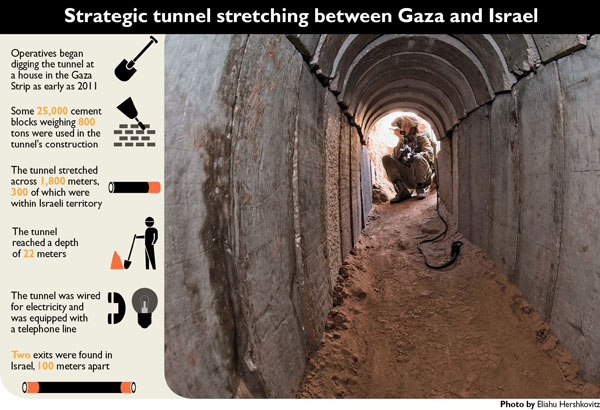
The IDF is aware of many such tunnels (I saw a report that some 20 or 30 have already been uncovered since the beginning of the ground action). Terrorists have been killed or captured in possession of heavy weapons and such things as handcuffs and anesthetics that would be used to take hostages. The amount of death and destruction that could be spread inside Israel if a group of gunmen succeed in infiltrating through these tunnels can only be imagined. Think of what 10 or 15 trained terrorists could do in a crowded city!

The tunnels take months to dig. They are lined with concrete — remember when the ‘international community’ was complaining about how the mean Israelis weren’t letting Hamas import cement and other construction materials? Apparently, between the smuggling tunnels under the Egyptian border that have just recently been destroyed by the al-Sisi regime and the materials Israel agreed to allow through its crossings in response to international pressure, Hamas got what it needed. Despite the fact that some 42,000 government workers did not receive their salaries for months, Hamas found the money to pay the tunnelers and the cement to build the tunnels.

What is clear is that it is not important whether this round of fighting was initiated by Israel or Hamas. Hamas has been preparing for it since the last one in November 2012, when it was only moderately wounded by operation Pillar of Defense. Since then it has been rebuilding its rocket forces, obtaining new weapons, expanding its underground bunker system and most important, digging terror tunnels. War was inevitable as soon as Hamas believed that it was capable of waging it. This is Hamas’ war, and Hamas is responsible for the consequences.

The Iron Dome system has saved countless lives. It has in effect neutralized Hamas’ rocket arsenal as a strategic weapon. On the other hand, it has made many people, inside and outside of Israel, think that it is possible to coexist with an armed Hamas by returning ‘quiet for quiet’.

It is not. Offensive and defensive technology and tactics move in lock step, with the advantage alternating to one side or the other. The threat of rockets may have been reduced (not eliminated) by Iron Dome, and the terror tunnels that today present such a great threat will also be dealt with, by a more brutal and lower-tech solution. But does anyone think Hamas will not come up with a new tactic?

Israel faces both a short-term and long-term challenge at this point. The short-term one is the need to hurt Hamas as much as possible while not giving in to the international pressure to stop fighting before Hamas is thoroughly disarmed. Hamas, of course, is doing its best to increase such pressure, crying victim and even encouraging its population to behave in ways that will create civilian casualties.

PM Netanyahu has been bragging about the degree of international support he is getting. Maybe he is, but in an unguarded open-mic moment, John Kerry let it slip that he personally — despite his official statements of support — does not think Israel is doing enough to reduce collateral damage, and that he wants to “get over there” and presumably rein in the IDF. Like other American officials, he appears to subscribe to the ‘cycle of violence’ theory in which both sides are morally equivalent.

Assuming that Kerry and other international players can be restrained for now, the longer-term issue is how to keep Hamas, or whoever rules the Gaza strip, harmless. That is a much, much more difficult question.

Posted in War | Comments Off on Hamas planned conflict long in advance

Some notes on law and war

Gaza tunnelMany observers have pointed out that the asymmetric nature of the conflict between Israel and Hamas greatly favors Hamas. Elan Journo argues that the international laws of war “abet Hamas [and] undercut Israel”:

We can all agree that civilian casualties are an unwelcome fact of war, but these laws are rigged against Israel in this conflict—rigged against any free nation acting in self-defense. The more scrupulously Israel complies with these norms, the more it abets Hamas and undercuts its self-defense.

Morally, in defending itself, Israel’s priority must be eliminating the threat from Hamas. Hamas has declared its goal of destroying Israel in no uncertain terms. It is responsible for devastating suicide bombings and, over the years, thousands of rocket attacks from Gaza against towns and cities in Israel. Yet, against this backdrop, the laws of war enjoin Israel to practice restraint and to subordinate the objective of self-defense in the name of safeguarding civilians in a war zone.

He has a point, but I would put it differently: it isn’t the content of the laws of war, but rather their unbalanced enforcement that favors Hamas.

Hamas does not simply commit war crimes in the process of fighting. The Hamas strategy is, quite simply, based on the commission of war crimes. Their offensive weapons are deliberately aimed at Israeli civilians, and they fire them from within their own population, with intent to deter Israel from striking back. These are both war crimes.

There is no doubt that Hamas is violating international law with intent, while the IDF is going out of its way, to a greater extent than any other army in history, to protect enemy noncombatants. Despite some highly-publicized incidents, the total number of Gazan casualties in ten days of fighting is relatively low, and analysis shows that the complaint that a majority are civilians is probably false.  The accusation that Israel intentionally targets civilians has no basis.

But there are two ways in which the laws of war are being misapplied. First, both because of Hamas’ status as a rogue non-state entity and its support from Iran, a rogue state itself, it is difficult to punish it for its transgressions. And second, because of the biased international establishment — the UN and the “human rights” NGOs — Israel is expected to adhere to an impossible standard of compliance. Given that no other nation has ever behaved in the way Israel is expected to, the hypocrisy of the establishment is blatant.

If this isn’t enough, biased NGOs and media continue to misinterpret the law in order to accuse Israel of violations. One of the most persistent misunderstandings is of ‘proportionality’, which only demands that the force an army uses must be proportional to its objective.

It would be a violation of the rule of proportionality if the IDF dropped a 1000-pound bomb on a car carrying a rocket-launching team, and killed 50 people in the vicinity (in fact, the IDF uses rockets with small warheads that effectively confine the explosion to a vehicle in such cases). Proportionality emphatically does not demand that casualties must be the same on both sides, or that an army use less force than needed to obtain its objective, just because the other side is weaker!

An army is also supposed to do its best to warn civilians away from areas where hostilities are taking place. It is not required to warn enemy combatants, and it is not required to forgo attacking legitimate military targets because of the presence of civilians unless an attack would constitute the use of disproportionate force (see the example above). Nevertheless, the IDF often does refrain from firing to protect civilians.

Israel may find that it is impossible to stop the Hamas rocket attacks and infiltration of terrorists via tunnels without causing a large number of civilian casualties, either by intensive bombardment of populated areas where the rockets, tunnels, or fighters are located, or by a ground invasion. In either case, Israel is justified in doing so as long as it follows the rules.

Here are some relevant points:

1. The IDF is not guilty of a war crime if it accidentally kills civilians when attacking legitimate military objectives, as long as it takes reasonable precautions (e.g., warning civilian populations) and as long as it uses proportionate force to obtain its objectives.

2. Hamas is guilty of at least two kinds of war crimes: deliberately attacking civilian targets, and using its own population as human shields. Hamas is also violating the UN charter by its aggression against Israel.

3. But — and the IDF knows this and acts accordingly — the behavior of Hamas doesn’t absolve the IDF from following the rules. Two wrongs don’t make a right (at the same time, there is no reason the IDF should be held to a higher standard of compliance than any other military force in history).

4. Even if the ratio of casualties between Hamas and Israel rises to 1000 to 1, this does not imply that Israel is using disproportionate force. There is no law that forbids one side from having a better army and better home-front defenses than the other.

5. International institutions, media and governments that accuse Israel of war crimes are either ignorant or deliberately biased.

Breaking: The IDF has announced that it has begun a limited ground invasion to neutralize at least 10 infiltration tunnels Hamas has built into Israeli territory. The tunnel in the photo above was discovered in October 2013.

Posted in War | Comments Off on Some notes on law and war

Israel chalks up another first in the history of warfare

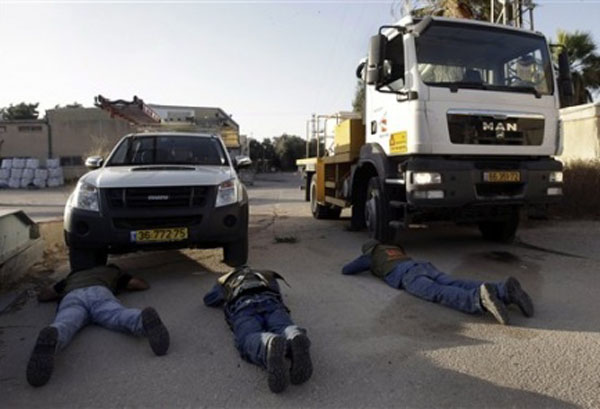
Workers of Israel Electric Company take cover from Hamas rockets

Workers of Israel Electric Company take cover from Hamas rockets

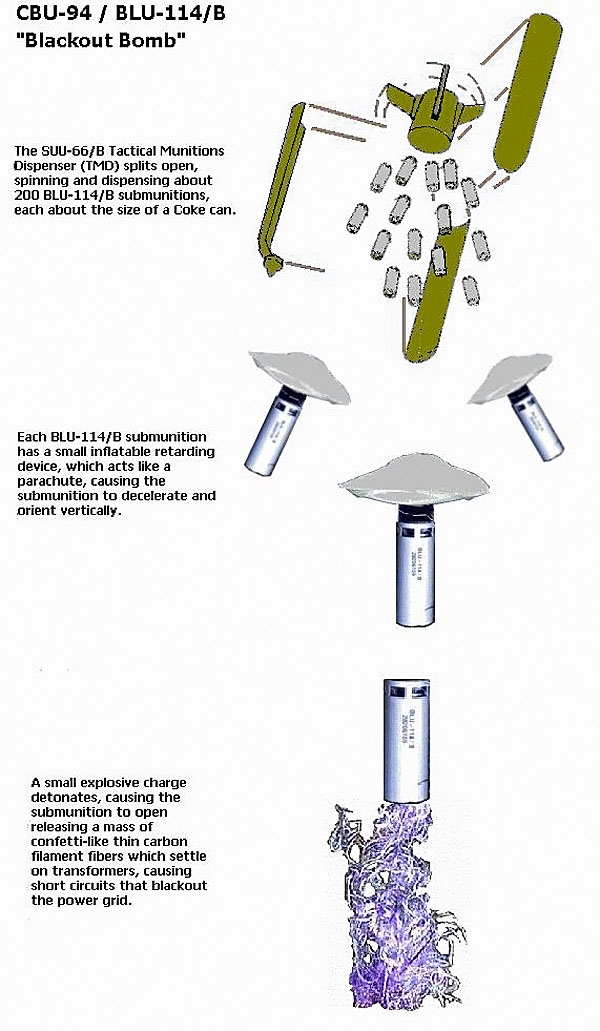
When the US attacked Iraq in 2003, one of the first weapons delivered by Tomahawk missiles was the BLU-114/B.

Sometimes called the ‘soft bomb’, ‘blackout bomb’ or graphite bomb, it is a canister packed with tiny electrically conductive filaments made of graphite. It is employed like a cluster bomb, in which many bomblets are dispersed over the target. Unlike the cluster bomb, however, it is not directly harmful to humans.

Rather, it is death to electric power grids. The filaments are dispersed in a cloud, and settle on insulators, switchgear, transformers, etc. Since they are conductive, they produce short-circuits which can give rise to massive arcs which melt equipment, start fires or even cause explosions.

Bombs like this were used with great effectiveness by NATO in Serbia in 1999, and by the US against Iraq. It only makes sense: electric power is critical to transport and communications.

But strategic warfare is apparently not permitted to Israel. In fact, the opposite is true. Israel has supplied Gaza with food, water, medicines, fuel and electricity during all of the ongoing conflict, and it would likely be accused of crimes against humanity if it stopped.

In a series of events whose absurdity surpasses anything in the novel Catch-22, a rocket fired by Hamas with the intent to murder Jews struck a high-voltage line in northern Gaza and blacked out 70,000 Gazans — doubtless including workshops used to construct rockets.

One might think that this “own goal” saved Israel the trouble of doing the job itself, but it doesn’t work that way. In today’s world, Israel had no choice but to restore power, which its Electric Company workers had to do under fire, wearing bulletproof vests and shrapnel-resistant helmets.

This absolutely must be a first in the history of warfare!

Oh, did I mention that the Palestinians are about $200 million in arrears on their electric bill? Don’t try that in California, or they will turn it off in a wink.

***

For those who are interested, here’s how the BLU114/B works:

BLU-114/B

Posted in War | 1 Comment

US Jewish establishment clings to dogmas of the past

It is immensely frustrating to watch the liberal Jewish establishment in the US cling to the leftist dogmas of the 1980s and 1990s, while a tsunami of change in the Middle East makes these ideas obsolete.

For example, the former head of the Union for Reform Judaism, Rabbi Eric Yoffie, published an article entitled “Stop the rockets, stop the settlements” which was read aloud by rabbis in more than one Reform congregation this past Friday night. Because much of it was numbingly familiar, listeners might be excused for failing to notice how disconnected with reality it was:

First, rockets. With missiles flying, no Israeli government of the right or the left will agree to a two-state solution or to any other kind of peace. Opposition leader Isaac Herzog and Prime Minister Netanyahu are speaking the same language on Gaza, and American Jews, whether doves or hardliners, should support them. …

Second, settlements. Israel’s settlement policy is an utter disaster. It has no supporters of consequence anywhere in the world. It has caused tension with the American government and infuriated Israel’s European allies. It has played into the hands of Israel’s most dangerous enemies, Hamas included, by allowing them to divert attention from their own radical intentions to settler extremism and Israeli occupation. And it has angered those moderate elements of the Palestinian Authority with which political arrangements leading to peace might still be possible. …

[Justice Minister Tzipi] Livni called for construction in the settlements to be frozen. Understandably reluctant to criticize Israel, American Jews are nonetheless firmly in Livni’s camp. They know that a freeze is right and also politically wise. The conflict with Hamas over Gaza could be long and ugly, and with a settlement freeze in place, it will be far easier to build the coalitions of support, in America and abroad, that Israel will require.

As you may guess, I don’t disagree with him about the need for American Jews to support Israel’s military action against Hamas. But I think he is wrong about ‘settlements’, and wrong to suggest that there is a connection between the two issues.

Yoffie and I both know that Hamas’ problem is not ‘The Occupation’, if this means Jewish communities in Judea and Samaria established since 1967. Hamas opposes Jewish sovereignty anywhere between the river and the sea, and advocates killing and expelling Jews to return the land to its ‘true’ Muslim owners. Even a complete evacuation of Jews from lands liberated from Jordanian control in 1967 would not end its hostility, just as the 2005 withdrawal from Gaza enabled rather than ameliorated it.

But Yoffie is mistaken in thinking that expanding the Jewish presence anywhere in the land of Israel ‘plays into the hands’ of radicals. The opposite is true: Israeli concessions in Judea and Samaria, including a ‘settlement freeze’ are interpreted by radicals and ‘moderate’ Arabs alike as weakness, and invite more ‘resistance’ (terrorism) from them. And if the withdrawal from Gaza was an indicator of what to expect, it would not result in increased support from the US, which reneged on promises made before the withdrawal, or Europe, which simply pushed for more concessions.

An ultimate withdrawal from Judea and Samaria, to which a freeze is a precursor, would enable radicals to attack Israel in more concrete ways as well. A hostile presence in the high ground above Israel’s coastal plain would make Tel Aviv  and Ben Gurion airport as vulnerable to rocket fire as Sderot is today. The Jewish state would not survive under such conditions. Further, unless the IDF can dominate the Jordan Valley, it can’t be defended from invasion from the east. As we are beginning to notice, there are some very bad actors in the east these days.

This is not speculation. There are clear precedents: Israel abandoned Gaza, the radicals took over, and it became one big rocket launcher. Israel, thankfully, did not abandon the Golan — although you may remember, it came dangerously close to doing so — and today has an advantageous strategic situation with respect to the Islamist rebels there.

Yoffie seems to hold out hope for “political arrangements leading to peace.” This is  the clearest possible case of events outstripping ideology! The Potemkin-village Palestinian Authority is incapable of making or keeping a peace agreement, and even if it could, Israel can’t afford the security consequences of giving up control of most, if not all, of Judea and Samaria in today’s Middle East. The “two-state solution” is a non-starter, but the liberal Jewish establishment can’t seem to deal with that.

David P. Goldman has a brilliant analysis — brilliant because it is so obvious and yet nobody else seems to have noticed — which states that the political deterioration of Israel’s neighbors and their declining birthrates combined with Israel’s high (and increasing) birthrate and powerful economy, imply that the only stable solution for the region is Israeli control of the land between the river and the sea:

The historical homeland of the Jewish people will pass into Israeli sovereignty not because the national-religious will it to be so, or because an Israeli government seeks territorial aggrandizement, but because Israel will be the last man standing in the region, the only state able to govern Judea and Samaria, and the only military force capable of securing its borders. It will happen without fanfare, de facto rather than de jure, at some moment in the not-too-distant future when the foreign ministries of the West are locked in crisis session over Iraq or Syria. And it will happen with the tacit support of Egypt, Jordan, and Saudi Arabia.

It’s remarkable that even as some Arabs are beginning to understand that there is already a “new Middle East” (not the one predicted by Shimon Peres, but certainly different from the old one), the American Jewish establishment is stuck in the past.

Posted in American Jews | 3 Comments

How to bring the war to Hamas

Al-Shifa Hospital in Gaza. The main Hamas command and control bunker in Gaza is located underneath it.

Al-Shifa Hospital in Gaza. The main Hamas command and control bunker in Gaza is located underneath it.

As everyone knows, Hamas has embedded its command posts, rocket launchers and weapons storage facilities within the civilian population of Gaza. This makes it difficult to destroy them from the air without large numbers of civilian casualties. It is also the case that important installations are underground where they are difficult to destroy from the air.

I have been expecting (and I admit it, hoping for) the IDF to mount a ground attack against Hamas in Gaza. But there may be an alternative, better, approach.

The very knowledgeable Dr. Mordechai Kedar lists some of the difficulties of going after Hamas in the heavily populated Gaza city area:

1. Population size and density, especially in urban areas such as Gaza City, Khan Yunis, Rafiah and the refugee camps make it necessary for Israel to introduce large infantry forces to a considerable number of points.

2. A tank has no advantages in urban areas as it has limited maneuverability, cannot aim at upper floors and is a slow-moving, easily hit target for antitank weapons, such as RPGs and rockets.

3. An armored jeep is also an easy target for antitank weaponry in a built up area.

4. Soldiers making their way on foot in built up areas are sitting ducks for snipers. Hamas has laid mines, built tunnels underneath the houses, fortified sniper positions in strategically placed buildings.

5. Eliminating Hamas military and civilian infrastructure requires a large Israeli presence over a lengthy period of time, enabling Hamas to attack command posts and headquarters (that is what occurred in Tyre).

6. Total elimination of Hamas will not prevent its resurgence as soon as our soldiers leave.

Kedar makes two points: that the ground attack would be costly — both to Israel and to the civilian population — and not assured of success, and that even if the Hamas infrastructure were completely destroyed, a permanent IDF presence would be required to keep it from being rebuilt.

Keep in mind that Hamas is depending on the “international community” to force a cease-fire and then help it rebuild; this will be accelerated by civilian casualties in Gaza. It has therefore encouraged its population to become human shields by ignoring IDF warnings, even going to rooftops of houses that are expected to be bombed.

Hamas sees casualties both among IDF soldiers and Gazan civilians as advantageous, and is doing everything it can to force Israel into a ground war in order to increase them. It certainly has been behaving as though this is its aim, deliberately crossing red lines and bragging about its intentions.

Here is Kedar’s strategy:

1. Israel must not enter Gaza and continue dealing with the problem from the air, where Israel has a significant advantage over Hamas and the other terror organization.

2. Israel must continue and expand its targeted assassinations against activists and leaders Israel must give Hamas political leaders clear warning that continued rocket launching will lead to their elimination.

3. Israel must announce publicly that two days after the aforesaid announcement, it will shut the supply of electricity, water, food and fuel to Gaza, and that this will continue until the rockets cease. Israel can also threaten to cut off all line-based communication to Gaza that goes through Israel. There has never been a situation in which a country continues to provide supplies and services to an area from which it is being shot at. This two days in advance warning is intended to deal with legal, public, political and media issues that might result from the cutoff.

The third point is important because Israel is providing a propaganda victory to Hamas by its humanitarian policies, enabling it to retain popular support:

Our side keeps saying: We differentiate between terrorists and civilians: we fight terror and send food to the civilians. There is nothing more infuriating and incorrect, because think about it – who hands out the food to the people? Israel or Hamas? In other words, the people thank Hamas for succeeding in blackmailing Israel into transferring food even though Hamas is raining missiles on Israel.

We say that we are transferring food and fuel so that world media will report it. This, too, is a faulty approach, because it is based on a twisted scale of values, according to which Israeli lives are less important that Israel’s image.

Continuing to transfer food, water, fuel and electricity, is seen as a sign of weakness by  the other side, and weakness invites more pressure in the form of rockets and missiles. Stopping the supplies would cause the residents of Gaza to demand that Hamas cease to launch rockets. Clearly, continued transfer of supplies is the reason for the continued rockets.

Kedar would prefer that Hamas — a humiliated and weakened Hamas — maintain control of Gaza, while being forced to stop its aggression against Israel.

I think he’s right about the contradiction between ‘humanitarian’ assistance and warfare. After all, the population of Gaza overwhelmingly voted for Hamas in 2006, and overwhelmingly supports its objective of killing Jews. We have no obligation to place the well-being of Gaza’s population over that of our own. The opposite is true!

If we cut them off, we can expect great international pressure to resume the transfers. Our response can only be: “yes — as soon as Hamas stops its attacks and begins to disarm.” Continued transfer will depend on the progress of disarmament.

I don’t suggest that we embark on this course unless we are prepared to follow through, because surrender to pressure would be far worse than not taking it at all. It must be made clear that the fate of Gazans is in Hamas’ hands, not ours.

Unfortunately, Hamas is probably correct that this war will end with an imposed cease-fire like previous conflicts. Our strategy should be designed to 1) hurt Hamas as much as possible — materially and psychologically — before this occurs,  2) establish conditions afterwards that will work against a recurrence of the conflict, and 3) protect our own people, both civilians and soldiers.

It is possible to combine air attacks with small, targeted ground operations by special forces without committing to a major ground offensive that sees dozens of tanks rolling across the border. I think that this can be combined with a cutoff of Gaza’s lifeline as advocated by Kedar to best achieve our goals.

Posted in War | 4 Comments