Will American taxpayers keep building Hamas’ army?

US-trained and equipped Palestinian Authority security forces in Jenin, 2013

US-trained and equipped Palestinian Authority security forces in Jenin, 2013

On Monday, if we can believe Mahmoud Abbas, a Palestinian unity government will be formed by the two major factions, Fatah and Hamas. A ‘technocratic’ government will be formed immediately until elections can be held next year.

‘Technocratic’ is a great word. It suggest a government of people interested in economics, sanitation, education, etc., and not in launching rockets, kidnapping soldiers, or stuffing explosives into tunnels underneath the border. The classic technocrat is former PA Prime Minister Salam Fayyad, who proved too technocratic (read: opposed to corruption) even for Abbas. Somehow I’m not optimistic about finding many technocrats in either Fatah or Hamas.

Abbas claims that the policies of the new government will be the existing policies of the PA, which ostensibly include nonviolence, recognition of Israel, and adherence to prior agreements (please don’t laugh too loudly). Hamas explicitly rejects these conditions, and plans to retain its weapons and continue its “resistance.” Apparently the EU is satisfied with Abbas’ assurances and will continue supporting the PA.

What about the US? The Consolidated Appropriations Act of 2012 says that

None of the funds appropriated in titles III through VI of this Act may be obligated for salaries of personnel of the Palestinian Authority located in Gaza or may be obligated or expended for assistance to Hamas or any entity effectively controlled by Hamas, any power-sharing government of which Hamas is a member, or that results from an agreement with Hamas and over which Hamas exercises undue influence.

That would seem to mean that the US will have to stop sending US taxpayer money to the Palestinian Authority (PA) as soon as the unity government is established. This is strong, aggressive language, which probably gave some members of Congress and their constituents a warm feeling when it was passed.

But the law also contains a presidential waiver clause. The President can suspend the requirement for 6 months at a time  if he thinks US national security requires it. Unlike the waiver clause in the Jerusalem Embassy act of 1995, which can be renewed indefinitely (and so far, has been), this one can’t be renewed after 12 months. So theoretically, unless Hamas turns into a bunny rabbit, the US will have to stop funding the PA, training its ‘security’ forces, etc. in at most a year.

The PA manages to absorb every dollar and euro it gets, while still barely managing to stave off insurrection. It would not survive without US aid.

Given the attitudes of the present administration, I can’t imagine that the it will let the PA, in which it has invested so much — both financially and in policy — fall. So I predict that unless something very disruptive (like a war with Israel) happens, a way will be found to continue aid past the deadline, despite the partnership with Hamas.

Which brings up the most surreal aspect of all this. Since 2005, the US has provided training and equipment for the PA ‘security’ forces by means of the “United States Security Coordinator for Israel and the Palestinian Authority (USSC),” a post held by Gen. Keith Dayton, Lt. Gen. Michael Moeller, and now Vice Adm. Paul J. Bushong.

In essence, the US is operating a military mission to the PA to build it an army. The rationale is that it needs one to “combat terrorism,” which until now has meant to keep Hamas from overthrowing the Fatah-dominated PA.

Now, however, Hamas will not need to employ the tactics of its 2007 coup in Gaza, when it shot Fatah supporters in the knees and pushed them off tall buildings (yes, if you are wondering, there are still some hard feelings in Fatah over this). It can proceed more or less peacefully and even democratically to take over the PA by winning elections.

So does the PA still need an army? Will the US keep training its soldiers and equipping it?

Who, after all, would they fight with it?

Posted in US-Israel Relations | 1 Comment

Do they have a right to a state?

And so I renew the appeal made in this place by Pope Benedict XVI: the right of the State of Israel to exist and to flourish in peace and security within internationally recognized borders must be universally recognized. At the same time, there must also be a recognition of the right of the Palestinian people to a sovereign homeland and their right to live with dignity and with freedom of movement. — Pope Francis, May 25 [my emphasis]

This raises many fascinating philosophical questions. Does every people have such a right? Does every group that calls itself a ‘people’ have one? Is it a ‘natural’, inherent right, like a person’s right to life, or does it have to be earned? What if there are conflicting rights? What if one group behaves as if the only way its rights can be realized is by denying them to another?

You get the idea. President Obama prompted similar thoughts when he said that “the Palestinians deserve a state.” Deserve? Why?

The earliest stirrings of Palestinian nationalism go back no farther than the early 20th Century. Before that, the Arabs living in the provinces of the Ottoman Empire that overlapped ‘Palestine’ — for the sake of argument, the area from the river to the sea, from today’s Lebanese border to Egypt — were just Arabs, like the ones in southern Syria.

There was no historical state of Palestine, nor an indigenous Palestinian civilization. There were Arabs, along with various other ethnic groups, including of course Jews. Some of the longer-resident Arab families may even have been descended from Jews converted to Islam during the Muslim conquest of the area in the 7th century!

The British promised to assist the development of a Jewish state in Palestine in accordance with the terms of the Mandate established at San Remo in 1920. Before it went into effect, they chopped off the three-quarters of the land that lay east of the Jordan and gave it to their friend Abdullah, who had helped them expel the Ottomans.

But the Arabs of the Mandate would not countenance Jewish sovereignty anywhere in Palestine. Incited by the man who would become their leader, Haj Amin al-Husseini, they engaged in deadly riots in 1920-21, perpetrated a pogrom in Hebron in 1929, rejected the Peel Commission recommendations of 1937 which called for partition of the remaining land into a small Jewish state (25% of what was left of Palestine) and a large Arab one, and began a violent revolt against both the Jews and the British — who nevertheless continued to do their best to frustrate the Jews’ aspirations for a state.

From the beginning the Arabs asserted a ‘right’, not only to a state, but to every inch of the land.  More recently, they rejected several additional offers of partition. In each case the grounds for rejection appear to be the insistence on a ‘right of return’ which would in effect bring about Arab sovereignty over all of the land, and a refusal to agree to a final end of the conflict — that is, to admit that the Jewish state is here to stay.

Mahmoud Abbas has said that not one ‘Israeli’ (please don’t bother to argue that in this context it means anything different from ‘Jew’) will be allowed to live in the new state of Palestine. But, on the other hand, he demands that the descendents of Arab refugees must have a right to live in Israel, if they so choose. Indeed, these ‘refugees’ will not be invited to live in the new state — they can only go to Israel!

The Palestinian refusal to accept Israel as  Jewish state — something that the historically ignorant Martin Indyk found so hard to understand — is the basis of the conflict, and has been such since the Mandate period, when the Arabs so strongly opposed Jewish immigration because they feared it might lead to Jewish sovereignty.

By what principle can this demand for all the land be justified, this demand not only for an Arab state, but for the negation of a Jewish one? Certainly not by an appeal to indigenous status or prior political control.

If they don’t have an absolute ‘right’, it could still be argued that for some reason they ‘deserve’ a state. But I certainly can’t think of one. The ‘father of their nation’ is al-Husseini, who was an ally of Hitler. Their most revered leader was Arafat, a mass murderer who popularized terrorism as a political tool, and who was probably more responsible for the automatic association of ‘Arab’ with ‘terrorist’ than anyone else.

Arafat exacerbated the ethnic conflicts in Lebanon leading to a bloody civil war, started a mini-war in Jordan in 1970, and was responsible for Israel’s 1982 invasion of Lebanon. It’s hard to find a single worse actor in recent history short of Stalin and Hitler. But he is the greatest hero of all time to Palestinians.

They lie about everything. The create fake atrocities to smear the IDF (one is in progress now). They have a made-up version of history that gets wilder every day. The Jewish Temple didn’t exist, they say. “Jesus was a Palestinian,” they say. Was he an Arab? A Muslim? A Canaanite? What Temple did he throw money-changers out of? This is so far beyond nonsense that it’s impossible to respond, but it’s used to justify both their crimes and their demands.

The culture, thanks mostly to Arafat’s educational and media systems, is obsessed with death, martyrdom, and revenge. Palestinians make it clear to anyone who is prepared to listen that their greatest aspiration is to destroy the state of Israel, kill or expel the Jews, and take the land that they believe they have a right to.

In a moral sense, then, are they ‘deserving’?

The Pope mentioned the “right to live with dignity and freedom of movement.” I presume he is referring to the security barrier. But the barrier was built because allowing Palestinians total freedom of movement led to hundreds of Israelis dead from bombings and shootings. Does the Pope think they have a ‘right’ to go where they want to kill whomever they want?

What does he think?

Posted in Israel and Palestinian Arabs | 2 Comments

The Presbyterian assault on Israel

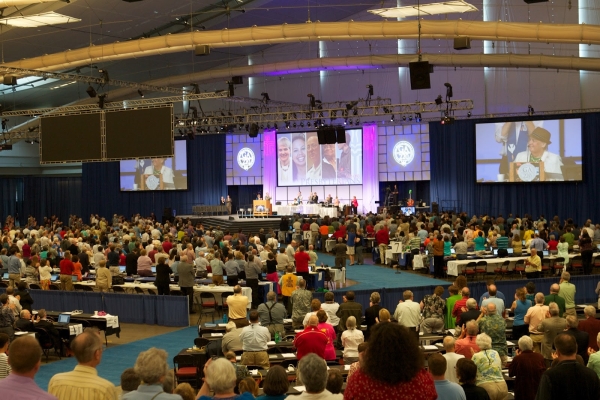
General Assembly of the Presbyterian Church (USA) in 2012, when a resolution to divest from companies doing business with Israel failed by 2 votes

General Assembly of the Presbyterian Church (USA) in 2012, when a resolution to divest from companies doing business with Israel failed by 2 votes

The Presbyterian Church of the USA – PC(USA) – is one of the largest ‘mainline’ Protestant denominations in America with about 10,000 congregations and 1.8 million members. It has been steadily losing membership since the 1980s, and recently lost several hundred of its more conservative churches over the question of ordination of gays and lesbians.

Since 2004, the PC(USA) has passed resolutions calling for Israel’s withdrawal from all territory captured in 1967, right of return for Arab refugees, and suggesting that its board divest from companies doing business with Israel until ‘the occupation’ is ended. But the organization stopped short by two votes (333-331-2) of passing an actual divestment resolution in 2012.

Its resolutions have consistently followed the Arab line in full and placed all the blame for the conflict on Israel. The 2004 resolution is entirely devoted to condemning Israel with the exception of one line criticizing “Palestinian suicide bombings.” This was their response to the Second Intifada which by then had killed 1000 Israelis, almost all of them innocent civilians!

Just in time for its 221st annual General Assembly starting June 14, the PC(USA) has published and is heavily promoting a “congregational study guide” on the conflict (the document is for sale and copyrighted. A scan is here. I have a local copy if it disappears).

One would think that a “study guide” would at least hint at the possibility of different points of view about such a controversial subject. But this document is a 74-page polemic against Israel. It is a catechism in the Palestinian narrative, as one-sided as anything I’ve read since the Hamas Covenant.

The thesis of the document is that the Israel acts illegally and oppressively because of its adherence to Zionism, a philosophy which it explains as a form of “exceptionalism” in which Jews are privileged above other peoples.

This study explores the theological and ethical exceptionalism of Jewish and Christian Zionism, which have been sheltered from open debate despite the intolerable human rights abuses rooted in their core beliefs. [p. 9]

Zionism, it argues, is a racial-religious belief in Jewish privilege and superiority, not simply a movement for the realization of self-determination for the Jewish people in their historical homeland. Despite the almost complete lack of a ‘racial’ aspect to the Israeli understanding of the struggle with Arab rejectionism, it leans on the race button so effective with North Americans:

In spite of its thoroughly secular origin, Zionism flourished, especially after 1967, because of the inextricable blending of its political and religious agenda. This is one example of the similarities between Zionism, South African apartheid, and Jim Crow segregation in the Southern [sic] US: All three ideologies are a political-religious blend, providing religious justification for the politics of racial or ethnic discrimination.

It proceeds to ‘demonstrate’ these things through historical falsehoods, misinterpretation of international law, fake quotations (the famous Ben-Gurion ‘quote’ calling for “compulsory transfer” invented by Ilan Pappé appears on p. 14), tendentious examples, and liberal use of extreme anti-Zionist Jews as sources — the aforementioned Pappé, Akiva Eldar, Avraham Burg, Henry Seigman, Philip Weiss, Brant Rosen, Ben Ehrenreich, Neve Gordon, Peter Beinart, etc.  — a veritable rogues gallery of Oslo Syndrome pathology!

Just to provide a flavor of the historical distortions throughout the paper:

In November 1947 the United Nations adopted a plan to partition Palestine into areas designated for a Jewish state and an Arab state. Each state would consist of both Jewish and Arab citizens, but tragically [!] no provision was made for an interim United Nations military force to protect the rights of minorities during the transition. As expected, war broke out between Jewish and Arab forces when Israel declared independence in May 1948. [my emphasis]

Why no mention of the fact that the Palestinian Arabs had been fighting to expel Jews from the region for at least 6 months prior to May 1948 (and had been perpetrating pogroms and terrorism against the Jewish population since the 1920’s)? War broke out? Is that the way to describe five Arab armies invading Palestine to once and for all wipe out the Jews and divide the land among themselves?

Every page provides new examples of the ugliness of this document (e.g., a paragraph headed “Binyamin Netanyahu: toward a single, Jewish, apartheid state”). There is a chapter about Israeli extremism (Baruch Goldstein, etc.), but no mention of the fact that the Israeli government and media severely condemn Jewish extremism while the Palestinian Authority celebrates the most vicious terrorists as heroes, and names schools after them.

There are chapters including stories about the ‘dispossession’ of Arabs in 1948 told without the slightest bit of context. There is one contrasting the “inclusive theology of the Qur’an with the exclusive theology of Zionism.” There is one arguing that Jews are happier and better off outside of Israel (tell that to Belgian and French Jews today). There are theological arguments refuting the view that Christians ought to be supportive of Zionism. There is the inevitable Beinartism about how American Jews are “cocooned” by the Jewish establishment to keep them from finding out about the oppression perpetrated by Israel against the Palestinians.

But this is a “study guide” which also includes notes for an instructor on how to present the material to what I assume will be a relatively naive audience. It is an 8-week course which includes the study guide, a book of essays and a supplementary DVD (which I haven’t seen). The authors recommend taking this long because

Your group will want to process what they experience during the sessions and to discern what God may be calling them to do after the series is completed.

The General Assembly next month will take up another resolution to divest from companies doing business with Israel. What do you think God will call on them to do?

Posted in Jew Hatred | Comments Off on The Presbyterian assault on Israel

The meanest bastards in history

So the Pope celebrates Mass in Bethlehem, but they can’t turn down the volume of the PA system at the nearby mosque? Listen:

Somebody was apparently trying to make a point, in case anyone wondered who’s in charge in Bethlehem.

And lots of Europeans were making the opposite point last weekend when they voted in surprising numbers (‘landslide’ is an exaggeration, but still) for parties that varied from radical Left to neo-Nazi — some of them moderate, others downright ugly — which shared one thing in common: an opposition to mass immigration of Muslims into Europe.

Yes, they were tired of EU regulations, unfair economic policies, etc. Some, like in almost-Jewless Hungary where the Jobbik party moved up to 3rd place with almost 15% of the vote, blamed the Jews. What else is new?

But above all they felt that immigration was out of control.

I was talking to a friend recently, saying that demographic trends pointed to an Islamic Europe sooner rather than later. “Don’t be so sure,” he said. “Europeans have a huge potential for violence. They’ve been the meanest bastards in history. Maybe they’ll rise up and fight.”

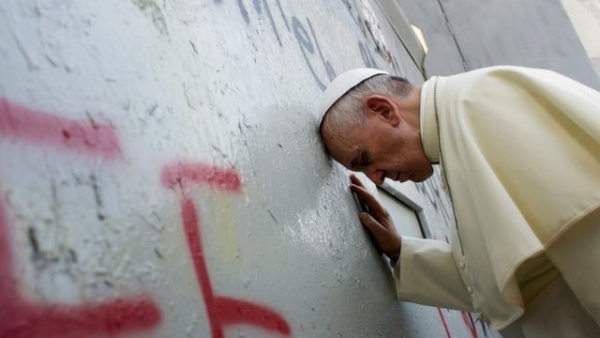
Pope Francis prays at security barrier, near Bethlehem, May 25, 2014

Pope Francis prays at security barrier, near Bethlehem, May 25, 2014

The Pope caused some excitement when he prayed at a concrete portion of the security barrier near Bethlehem. Palestinians claimed that he was praying that the barrier, which was built to prevent Arab terrorists from crossing into Israel and murdering people, would be removed. My thought is that he was praying for the Palestinians to stop promoting murder as a national goal so that it could be removed.

I mentioned this to another friend, who said something like “what do you expect from a saint? He can’t stop loving all humanity!”

That doesn’t seem to describe the feelings of most Europeans today, though.

Posted in Europe and Israel, Islam | 2 Comments

Who shot them? (Updated)

Were two Palestinian teenagers shot to death in cold blood by Israeli soldiers on May 15, nakba day?

Palestinians say that video evidence shows that two youths were shot far from any action, when they were not threatening soldiers or Border Patrol officers in any way. This is in effect an accusation of murder.

While we don’t know (yet) for certain what did happen, it seems clear that the Israelis that were accused of shooting them did not do so — and most likely they were not shot with an Israeli military weapon.

There are two videos in question. One is taken by security cameras at a nearby business, and another was taken by a Palestinian cameraman working for CNN, Kareem Khadder.

Nadeem Nouwareh

The security camera footage shows two Palestinians falling to the ground (about 73 minutes apart). It does not show their faces. The first one is Nadeem Nouwareh (also called Nadeem Abu Qaraa in some reports).

Nouwareh, who is supposed to have been hit in the chest, falls forward and puts his hands out to break his fall. Experts say that this is unlikely, that someone hit in the chest with a high-powered bullet will normally be pushed back by the force of the bullet.

The Khadder video shows a nearby Israeli position. The camera shows one of the Border Patrol officers firing and then quickly pans to the location of the Palestinians, where they are seen rushing to pick someone up and put him in an ambulance. It does not show either of the two being hit.

The weapon used by the Border Patrol officer has a rubber-bullet cassette clearly visible on the barrel. The cassette holds the rubber bullets, which are propelled by firing blanks from the rifle’s normal magazine.

While it is possible to fire live ammunition with the cassette in place, the sound of the shot is quite different, and would have been noticed by everyone at the post. Unless there was a conspiracy including all the Israelis present, this did not happen.

CNN’s broadcast includes an interview with Nouwareh’s father, who displays a bullet he says was found in Nadeem’s backpack after it passed through his body.

The spent bullet that is displayed looks like a 5.56 mm bullet of the type that is used by Israel (and also by the weapons supplied to the Palestinian security forces by the US). Bullets like this can be picked up at firing ranges around the country.

The bullet, which supposedly penetrated Nouwareh’s chest, exited his back, and then was stopped by a hard object (like a book) in the backpack, is only slightly deformed. An expert interviewed by Israel’s Channel 2 — and another that I spoke to — both said that it was certain that under these circumstances it would have been crushed almost flat.

The backpack has a small hole and a small bloodstain on it. Inside, the father displays a book that appears to have a red substance wiped across it. I can’t see how the bullet would have carried that much blood inside, or why it would be smeared across the page.

Mohammad Odeh Salameh

The second victim is Mohammad Odeh Salameh (initial reports gave his name as Mohammad Mahmoud Odeh Abu Daher), said to be hit in the back with the bullet exiting his chest. In the poor quality security video, he appears to be hit, falls to his knees, and then rolls over. The CNN broadcast shows a still picture of him on the ground, apparently after the shooting, taken by Palestinian photographer Atef Safadi. Here is a screen capture from about 2:48 into the broadcast:
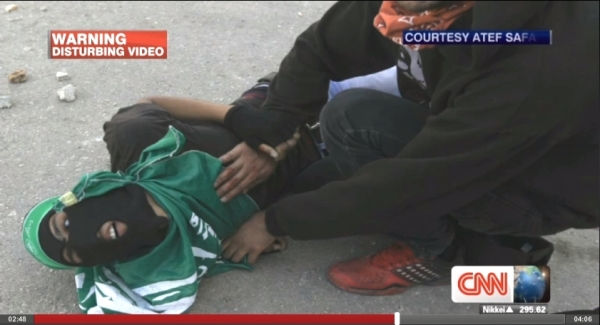
Atef Safadi photo of Mohammad Odeh Salameh on the ground

Atef Safadi photo of Mohammad Odeh Salameh on the ground

This photo corresponds to the point 1:45 into the security video when the photographers rushed up to take pictures. The person in dark clothes is the first one to reach Salameh, possibly a doctor. He is seen throwing down a black bag and then kneeling. He appears to move Salameh around, feeling his chest and back, possibly searching for wounds. Absolutely no blood is seen anywhere.

Another Safadi picture (not in the CNN broadcast) shows Salameh a moment later. There is still no blood visible on his clothes or the hand of the man in dark clothes, who is apparently holding it over the exit wound:
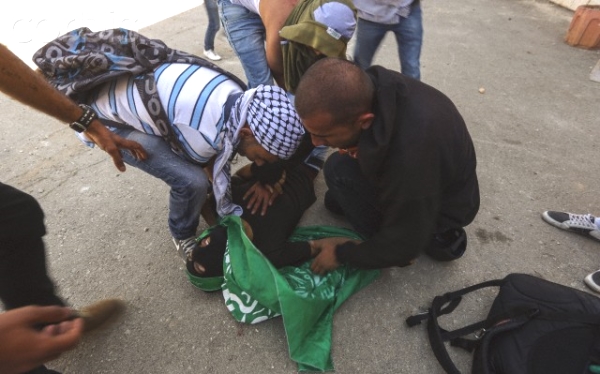
Photo of Salameh a few moments later. Still no blood.

Photo of Salameh a few moments later. Still no blood.

The 5.56 mm bullet of the type used in the Israeli weapons visible in the Khadder video has a tendency to tumble and fragment in the body, especially if it hits bone, as is likely if it passes through the chest either from the front or the back. It would make a small entry hole, an expanding wound channel and a large (several inches) exit wound. Bleeding would be profuse, and a large amount of force would be transferred to the body, knocking it away from the direction of impact. None of this was visible in either case.

A photographer interviewed by Ha’aretz adds more complexity to the story:

Agence France-Presse photographer Abbas Al Momani told Haaretz that the Israeli forces at the Beitunia incident had split into two groups.

“Some of the troops, mostly Border Police, took position in a high building overlooking the road, some 50-to-60 meters away [these are the ones in the CNN video -ed.]. Another group was in the prison parking lot, and they were even farther away, more than 150 meters away,” he said.

Momani said that during the demonstration, dozens of youngsters hurled rocks at the troops, who retaliated with rubber bullets and smoke grenades. “The youths were hit when things had calmed down. That’s why I and my colleagues were sitting in the shade, rather than standing at the scene. We felt the incident was winding down. There were a few dozen boys still at the site, most of them school students,” he said.

Momani said the photographers can distinguish rubber bullets from live fire. Throughout the incident, the soldiers shot rubber bullets, but “the live bullets came in isolated shots,” he said.

“We heard the shots well, but I can’t say if they came from the troops in the building or the other group. But there’s no doubt that during the shooting, there was no confrontation, and the youths did not approach the soldiers,” he said.

Conclusions [updated 5/28]

The security video could be a ‘Pallywood’ production like the al-Durah hoax in which no one was actually killed. At first, I suspected that two different Palestinians were killed that day, in direct confrontation with the IDF, perhaps throwing firebombs, and the video was an attempt to prove that two teens had been shot for no reason. But the IDF did not report any such incident and insists that no live ammunition was used anywhere that day.

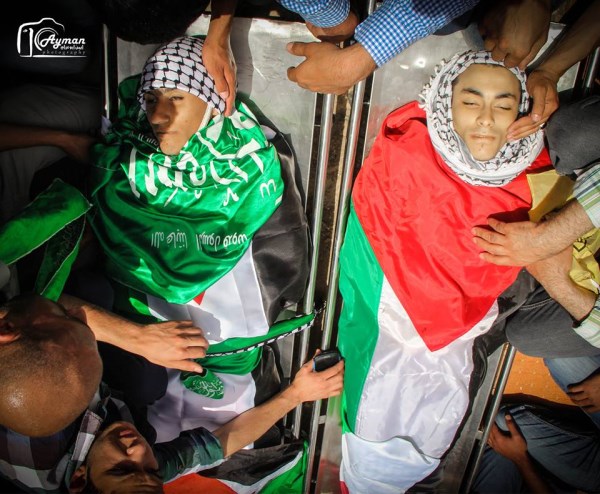
There was a funeral, and apparently two Palestinians were buried. The first still photo taken by Atef Safadi appears (despite the ski mask) to at least superficially resemble the one of Salameh taken at the funeral (he is the one in the back, draped with the green Hamas flag). The still seems to fit well with the security video. The original photo should be examined carefully by experts, but it appears not to be photoshopped.

So I conclude that the security video probably does show at least one Palestinian who was killed. But who shot him, and when?

The fact that 1) live fire at the Israeli post would have been immediately noticed (and the shooter arrested for a serious violation of rules of engagement and probably charged with murder), as well as 2) the way the victims fell when hit, and 3) the lack of any signs of blood or an exit wound on either of them, all argue that they were not shot with live ammunition by the soldiers at the post.

Were they shot by a sniper at another location, Israeli or Palestinian? Who were the “other group” photographer al-Momani referred to? If they were “at least 150 meters away” it would be hard to tell. Autopsy data about the direction of the wounds combined with the security video might clear this up, as well as the type of weapon used.

If the shooters were Palestinians, that would imply that Palestinians are monsters. But isn’t that what they are saying about us?

Update [26 May 2014 0956 PDT]: See Elder of Ziyon’s analysis here. He argues that Nouwareh’s fall was consistent with being hit in the leg with a rubber bullet, there is a mark on his right pant leg that could have been caused by such a bullet, and that the timing was right when compared to the CNN footage of rubber bullets being shot from the Border Patrol position. One expert that I spoke to also said that the way his right leg stiffened when he fell was characteristic of someone hit in the leg by a rubber bullet.

Elder of Ziyon sums up thus:

Now, what happened afterwards? I have no idea. If I am right – and I am convinced I am, at least in Nawarah’s case – then you have no choice but to say that either he was shot after this incident in the chest, or another dead body was buried, and either this isn’t Nawarah or that other person isn’t Nawarah.

Update [28 May 2014 2220 PDT]: Elder of Ziyon analyzes new footage which very persuasively points to an orchestrated ‘Pallywood’ production. All the facts aren’t in yet — we still don’t know who, if anyone, was killed — but the latest information is here.
Posted in Anatomy of a Blood Libel | Comments Off on Who shot them? (Updated)

More evidence that Palestinian teens were not killed by Israelis

As more evidence comes in, it appears increasingly unlikely that two Palestinian youths were shot in cold blood by Israeli soldiers (actually, Border Patrol officers) last Thursday.

CNN has broadcast video that purports to show a Border Patrol officer firing at Palestinian teens immediately before one falls to the ground and is taken away in an ambulance. Later, his father produces a bullet that he says was found in the boy’s backpack, which passed through his chest and killed him. Watch the video here.

Open and shut, right? Not exactly. I talked to an Israeli firearms expert, and here is what he told me:

1. The Border Patrol officers are shooting rubber bullets that are used for crowd control. They are not capable of penetrating the body at the range they are being fired from. We know this by the devices fitted to the barrels of the rifles — these cassettes contain the actual rubber bullets which are propelled by blanks fired from the gun’s regular magazine.

If the rubber bullet cassette had been empty and if the officer had replaced the blanks magazine with one containing live ammunition, then he could have fired a live bullet without removing the cassette. But everyone at the position would have heard the sound of the shot, which is very different from that of a blank propelling a rubber bullet. The Border Patrol officer would have been in very serious trouble, facing a murder charge if his target died. Unless all the soldiers were in on a conspiracy, this didn’t happen.

2. The bullet that the father of the victim said had been removed from the backpack was a 5.56 mm bullet such as is used by the IDF. But it was only slightly deformed. If it had passed through a person’s chest and then was stopped by books in a backpack, it would have been completely crushed. “That bullet looks like it was fired into sand,” the expert said.

3. The surveillance camera video shows the boy falling forward and putting his hands out to break his fall. A person hit by a bullet in the chest is shoved backward by the force of the bullet, his shoulders move forward and his chest is compressed. He falls on his back. The way the boy falls is consistent with someone hit in the leg by a rubber bullet.

Some of these points (particularly the description of the bullet) are also made in an Israeli Channel 2 broadcast (in Hebrew) which can be seen here. [See update below for version with English subtitles]

The most likely explanation is that the two Palestinians who died did so in a direct confrontation with the IDF or Border Patrol somewhere else. A firebomb is considered a deadly weapon, and they might have been shot trying to throw them. The teenagers in the video, then, were either injured non-seriously by rubber bullets, or faking for the camera.

The reports said that four Palestinians were shot, two injured and two died. Not much has been said about the ones who were only injured. Perhaps they were the ones in the video?

Update [23 May 0912 PDT]: Here is the Israeli Channel 2 report with English subtitles added:

Posted in Anatomy of a Blood Libel | Comments Off on More evidence that Palestinian teens were not killed by Israelis

More on the nakba-day ‘massacre’

Bodies of two Palestinians killed on May 15, 2014, wrapped in Hamas and PLO flags

Bodies of two Palestinians killed on May 15, 2014, wrapped in Hamas and PLO flags

The nakba-day shooting of two Palestinian ‘children’ has grown legs and is galloping around the world.

Both the UN and the US are demanding “transparent” investigations by Israel. The US State department has even tweeted its “condolences” to the families (can you imagine Israel demanding that the US investigate its drone-killings of Pakistani noncombatants, or expressing its condolences to the families of al-Qaeda terrorists it does kill?)

Given the multitude of of ‘Pallywood’ productions — fake videos used to impeach the IDF created by the Palestinians and distributed by gullible (often deliberately so) media — it behooves us (and the US State Department as well) to be extremely suspicious of such ‘evidence’ of Israeli atrocities.

It appears to be true that two Palestinians (whether they were ‘teenagers’ is  unclear) were shot dead last Thursday. But it is not at all certain that the video that was distributed shows the actual shooting, or the actual individuals who were shot.

The video appears to show two Palestinian youths, apparently far from any action, suddenly falling down. There are many aspects of it that raise questions: the way they fell, the lack of blood, the relationship of the reported wounds to the direction the fire is supposed to have come from, the way bystanders immediately rush in (unafraid of further shooting) and call cameramen over, etc.

Before convicting the IDF of murder, let’s consider the very likely possibility that two young men (one of the accounts puts one’s age at 22, and Hamas has claimed one as a member) were killed in a direct confrontation with the IDF — and the video was faked by actors in order to give the impression that innocent children who posed no threat were shot down in cold blood.

Frankly, I don’t believe the vicious lie that the IDF deliberately targets children — a case of projection if I’ve ever seen one, by the folks who gave us the Ma’alot massacre (22 children), the Bus of Blood (13 children), the Dolphinarium bombing (21 children), and who fire anti-tank missiles at schoolbuses (1 child). So I am much more likely to believe that the video is a fake.

I agree, therefore, with the US that there should be a complete and transparent investigation. The dead Palestinians are probably already buried, but if necessary they should be dug up, identified and autopsied. Evidence must be collected from the scene(s) and witnesses interviewed by investigators (and not only by pro-Palestinian media).

Yes, it would cause pain to the families. But IDF soldiers have been accused of deliberate murder of innocent children. That causes pain too.

Posted in Anatomy of a Blood Libel | 1 Comment

The Israeli Arabs

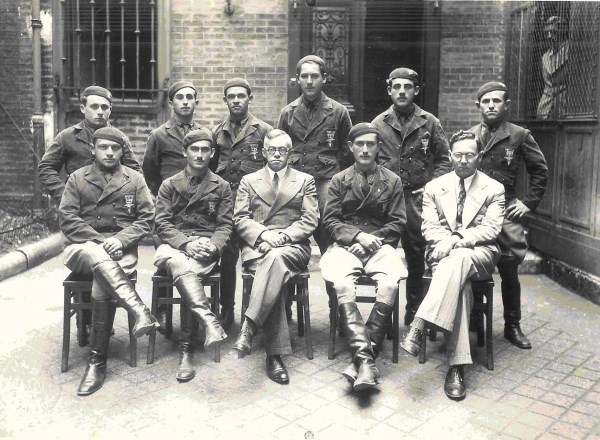
Ze'ev Jabotinsky (front row, center) with a group of Betar motorcyclists in Paris (1934)

Ze’ev Jabotinsky (front row, center) with a group of Betar motorcyclists in Paris (1934)

From TheTower.org:

An Israeli news station has reported this morning on a poll conducted by Professor Sammy Smooha of Haifa University showing that the acceptance of Israel by Israeli Arabs increased markedly between 2012 and 2013.

Channel 10/Nana reported (Hebrew) that the poll’s surprising results bucked conventional wisdom:

The research shows that between 2012 and 2013 there was an increase in the percentage of Israeli Arabs recognizing Israel’s right to exist as a Jewish and democratic state, and Israel’s right to maintain a Jewish majority. Similarly, the percentage of Arabs who define themselves as “Israeli Arabs” without a Palestinian identity has increased.

Among the specific results reported were that the percentage of Israeli Arabs who accepted Israel’s right to exist as a Jewish and democratic state rose to 52.8% from 47.4% the year before. There was a more pronounced rise in the percentage of Israeli Arabs who believe that Israel can exist as a Jewish majority state to 43.1% up  from 29.6% a year earlier. The number of Israeli-Arabs who accept their identity as such without identifying as Palestinians increased from 32.5% in 2012 to 42.5% in 2013. In 2013, 63.5% of Israeli Arabs consider Israel to be a good place to live up from 58.5% in 2012.

I don’t think this is so surprising. Israeli Arabs have relatives in the area controlled by the Palestinian Authority, and they understand very well that it is characterized by nepotic corruption, arbitrary police power and gangsterism.

But we shouldn’t fool ourselves into thinking that these Arabs are Zionists. Many of them are well-educated professionals who are pragmatic in their politics, but when there are conflicts, like the intifadas, Operation Cast Lead (2008-9) or the almost-war with Hamas that happened in 2012, attitudes become more nationalistic.

In fact, the results of the survey quoted could have more to do with the bad relations in 2012 than the better ones of 2013.

There are also some hard-core supporters of Hamas or other anti-Israel organizations among the Arab citizens of Israel. And it seems that the rhetoric from Arab members of the Knesset has not moderated very much.

On the other hand, there are positive trends, like the glimmer of understanding on the part of some Christian Arabs that they are much better off aligning with their Jewish neighbors than their Muslim Arab ones. They can see how badly Islamists — in Egypt, Syria and Gaza for example — have treated Christians. Even under the secular PLO, the Christian population of the territories has declined sharply.

Good relations between Israeli Jews and the 20% of Israel’s citizens who are Arabs are critical for the survival of Israel as a Jewish state. But how do we define ‘good relations’?

Arab residents face a choice — should they continue to live as a national minority in Israel (or go to another Western country), where they will have civil rights, a great deal of freedom, and economic opportunity; or should they move to an Arab country (even Gaza or the PA) where they would be part of the cultural majority but lack rights, freedom and opportunity?

This is up to them. The one option that must be closed to them is to live in Israel and insist on a specifically ‘Palestinian’ national identity that includes — as it must — the commitment to regain ‘Palestine’ (which, in fact, they never had) from the Jews.

Meir Kahane believed that coexistence on the same land was simply impossible. But Jabotinsky had a different view:

As long as the Arabs feel that there is the least hope of getting rid of us, they will refuse to give up this hope in return for either kind words or for bread and butter, because they are not a rabble, but a living people. And when a living people yields in matters of such a vital character it is only when there is no longer any hope of getting rid of us, because they can make no breach in the iron wall. Not till then will they drop their extremist leaders, whose watchword is “Never!”

And the leadership will pass to the moderate groups, who will approach us with a proposal that we should both agree to mutual concessions. Then we may expect them to discuss honestly practical questions, such as a guarantee against Arab displacement, or equal rights for Arab citizen, or Arab national integrity.

And when that happens, I am convinced that we Jews will be found ready to give them satisfactory guarantees, so that both peoples can live together in peace, like good neighbours.

Posted in Israeli Arabs | Comments Off on The Israeli Arabs